


Views: 0 Author: Site Editor Publish Time: 2026-10-24 Origin: Site


Operating road maintenance equipment requires precision, but the real challenge often begins after you shut off the engine. Cleaning your spraying machinery is not merely a housekeeping task; it is a vital operational necessity. Bituminous materials quickly harden when exposed to ambient air. If you neglect prompt cleaning, you risk irreversible curing inside valves, nozzles, and hoses.
This oversight inevitably destroys your consistent spray patterns. It also leads to premature pump failure. This guide provides a highly systematic approach to flushing and preserving your vital equipment. You will discover practical strategies to remove stubborn residue safely. You will also learn how to select proper solvents for different materials.
We will explore how to prepare your machinery for short-term downtime and long-term storage. By mastering these specific maintenance protocols, you avoid costly emergency repairs. Keeping a bitumen emulsion sprayer in optimal condition guarantees smoother field operations and protects your heavy equipment investments.
Time Sensitivity: Bitumen emulsion must be cleared immediately after use to prevent irreversible curing.
Solvent Strategy: Use industry-recommended cleaning agents; avoid harsh chemicals that degrade pump seals.
SOP Compliance: Consistent flushing extends the asset lifecycle and reduces downtime in field operations.
Systematic Approach: Break down cleaning into fluid-circuit purging, nozzle maintenance, and pressure-system storage.
Bituminous materials transition rapidly from fluid to solid. Manufacturers suspend microscopic bitumen droplets in a water-based carrier fluid. Once you spray this mixture, the water begins evaporating immediately. Air exposure accelerates this chemical breaking process. The suspended droplets coalesce into a solid, sticky asphalt layer. If this process happens inside your internal piping, the material cures into an immovable blockage. You cannot reverse this cured state using standard water circulation.
Ignoring daily maintenance carries severe operational penalties. A seized gear pump often requires complete disassembly. Hardened material can easily shear pump drive pins upon startup. Clogged manifold systems severely restrict fluid flow. This drops your application pressure significantly. You lose valuable days of productivity dealing with these avoidable mechanical failures. Routine flushing proves much cheaper than buying replacement parts and funding emergency mechanic visits.
You must define what a truly clean system looks like. A successful flush leaves zero visible buildup inside the main vat. Clear cleaning fluid must flow freely through the return lines. You should see no pressure spikes on your gauges during a dry run. Finally, you need entirely debris-free nozzle tips. Achieving these standards ensures your equipment remains ready for immediate deployment on the next job site.
Industrial-grade emulsions and cleaning solvents pose specific health risks. You must wear mandatory Personal Protective Equipment (PPE). Gloves, safety goggles, and respirators are non-negotiable. Emulsions stick severely to human skin. Many effective cleaning solvents emit Volatile Organic Compounds (VOCs). Protect your respiratory system during indoor maintenance. Always review the Material Safety Data Sheet (MSDS) before handling any unfamiliar chemical agents.
Gather your maintenance tools before you begin the shutdown procedure. You need dedicated flushing tanks positioned nearby. Prepare appropriate return hoses to handle dirty solvent. Keep soft-bristled, non-metallic brushes on hand for delicate scrubbing tasks. Never use wire brushes or abrasive steel wool. These harsh materials easily scratch precision-machined brass and stainless steel components. Scratched components attract more residue during future operations.
Balancing cleaning efficiency against mechanical compliance requires careful solvent selection. Water effectively flushes uncured anionic and cationic emulsions. However, partially cured residues require specialized emulsion-breaking agents. Avoid harsh chlorinated solvents. They aggressively degrade rubber pump seals and synthetic O-rings.
Table 1: Cleaning Fluid Comparison for Bitumen Emulsions
| Solvent Type | Best Application Scenario | Seal Compatibility | Environmental Impact |
|---|---|---|---|
| Clean Water | Immediate flushing of wet emulsion | Excellent | Low |
| Bio-Based Solvents | Softening partially cured residue | Good | Moderate |
| Diesel / Kerosene | Heavy buildup removal | Fair (may swell rubber over time) | High |
| Citrus Degreasers | Exterior surface cleaning | Good | Low |
You must establish a compliant wash-down area. Best practices dictate using dedicated catch basins for managing dirty wash-off. Never allow oily water to enter municipal storm drains. Follow all local environmental regulations regarding wastewater disposal. Use absorbent booms around your cleaning zone to capture accidental spills. Proper site setup protects your company from severe environmental fines.
Perform a strict Lockout/Tagout (LOTO) procedure. Verify energy isolation before disassembling any couplings or valves. Turn off the main power supply completely. Relieve all trapped pressure inside the fluid lines. Opening a pressurized valve can spray hazardous chemicals into your face. Confirm all gauges read zero before applying a wrench to any fitting.
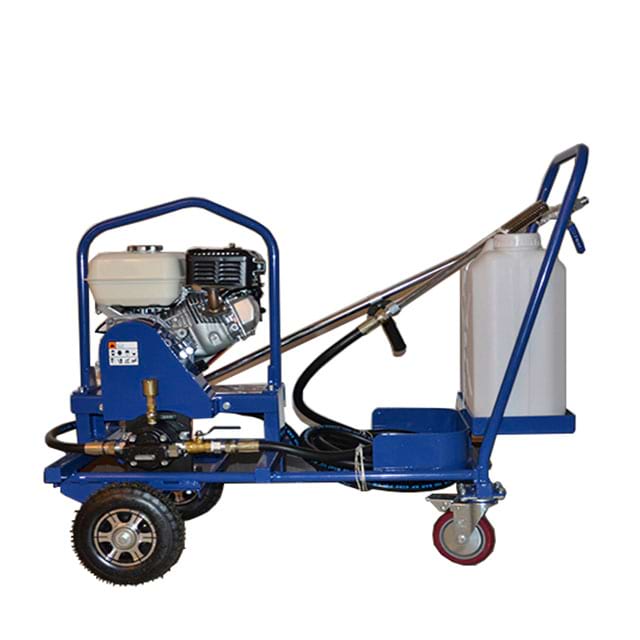
Start by pushing remaining emulsion out of the main circuit. Use compressed air to blow usable material back into the storage drum. This simple step saves expensive materials and reduces your cleaning burden. Next, introduce your selected cleaning fluid into the intake. Run the pump at a low RPM. Allow the fluid to push the remaining dark emulsion through the primary hoses until the output runs clear.
You must reach the dead zones inside the manifold and pump head. Set your system to recirculate the flushing fluid. This action creates internal turbulence. Turbulence acts as a mechanical scrubber, dislodging hidden particles from tight valve corners. Run this recirculation cycle for at least ten minutes. Monitor the fluid color. If it turns entirely black, drain it and introduce fresh solvent for a second cycle.
Spray tips require delicate manual handling. Remove the tips from your handheld bitumen emulsion sprayer and soak them in solvent. Use a soft nylon brush to clear the orifice. You should never use metal wire needles to clear clogs. Metal needles widen the precision-machined orifice. A widened orifice ruins your precise spray pattern and causes uneven asphalt application.
Intake strainers serve as your first line of defense against system-wide clogs. Locate the Y-strainer on your suction line. Isolate the valve and pull the mesh screen. Inspect it closely for hardened chunks and fibrous debris. Clean the mesh thoroughly using solvent and compressed air. Reinstall the screen carefully. A blocked strainer causes pump cavitation, which quickly destroys internal gears.
You must learn to detect internal material buildup early. Watch your pressure gauges during operation. Subtle pressure drops usually indicate intake starvation caused by a clogged filter. Conversely, sudden pressure spikes indicate a downstream blockage in the manifold or hose. Recognizing these early warning signs allows you to intervene before the machine completely seizes.
Do not chip away hardened residue using screwdrivers. You will inevitably gouge the metal surfaces. Instead, rely on professional softening techniques. Submerge the hardened components in a specialized bio-solvent or diesel bath. Allow them to soak overnight. The fluid will penetrate the porous asphalt matrix. By morning, you can easily wipe away the softened sludge using a shop rag. This protects vital rubber gaskets and delicate threads.
Sometimes parts are beyond recovery. Use this decision framework for your emulsion asphalt sprayer components:
Assess Flow Restriction: If an overnight soak fails to clear a valve, replace it.
Check Seal Integrity: If you see cracks or swelling on O-rings after cleaning, install new seals.
Inspect Threading: Cross-threaded or heavily corroded brass fittings demand immediate replacement.
Evaluate Labor Costs: If cleaning a cheap component takes three hours, buying a new part is more efficient.
The best troubleshooting strategy is prevention. Implement a strict daily flush cycle. Ten minutes of preventive maintenance negates the need for aggressive chemical descalers later. Make cleaning the official final step of your daily job site routine. Hold operators accountable for equipment condition. Consistent habits eliminate unexpected morning breakdowns.
Preparing equipment for the off-season requires special attention. After your final flush, introduce specialized storage fluids or light oils into the pump. Cycle the oil briefly to coat all internal metal surfaces. This protective film prevents internal oxidation during extended downtime. It also keeps rubber seals lubricated and prevents them from drying out and cracking.
Storage environments heavily impact equipment longevity. Temperature and moisture protection are absolutely vital. Store pumps and sensitive control modules indoors. Freezing temperatures will shatter metal housings if any residual water remains inside. High humidity environments cause rapid pitting on exposed steel components. Covering your machinery with breathable tarps prevents dust accumulation while allowing trapped moisture to escape.
Documenting maintenance logs is a professional necessity. Maintain a dedicated ledger for each machine. Record the date, the operator's name, and the specific cleaning agents used. Log any parts you replaced during the maintenance session. Good records ensure compliance with manufacturer warranty requirements. They also help fleet managers track individual equipment performance over multiple paving seasons.
Never send a stored machine directly to a new job site. Perform a comprehensive functional test first. Hook up a water source and run the pump.
Check for drips around main shaft seals.
Verify the pressure regulator responds smoothly.
Ensure spray wands trigger without hesitation.
Confirm all electronic safety shut-offs function properly.
Finding a leak in your maintenance yard is infinitely better than discovering a catastrophic failure mid-project.
Proper maintenance is the most effective way to maximize project reliability and protect your machinery investments. By adopting these rigorous cleaning procedures, you safeguard your hardware against the severe challenges of bituminous substances. Always prioritize prompt flushing, select correct solvents, and adhere strictly to safety guidelines. Implement protective storage protocols to ensure your equipment survives the off-season. Consult your operation manual or contact a technical support representative if you encounter complex system failures. Diligent care guarantees your sprayers perform perfectly whenever you need them.
A: You should clean it immediately. Even 30 minutes of idle time can lead to the onset of emulsion separation or premature setting. Once it begins curing, removal becomes significantly more difficult.
A: Most emulsions are water-based, making water a good initial flush. However, water alone may not suffice for heavy residue. Always check your specific emulsion’s data sheet for specialized cleaning recommendations.
A: Soak it in solvent and use a soft nylon brush. Never use metal tools or wire needles. Metal scratches the precision orifice, which will permanently ruin your spray pattern.
A: The material will cure into a solid state inside the pump, valves, and lines. This leads to severe blockages. You will likely face a complete tear-down or expensive replacement of the fluid circuit.
A: While some uncured emulsions are water-soluble, persistent residues usually require an emulsion-breaking additive. Using simple soap and water on partially cured asphalt often makes the cleaning process much messier.


