


Views: 0 Author: Site Editor Publish Time: 2026-11-14 Origin: Site


Crack treatment on asphalt and concrete pavement is among the most common — and most critical — maintenance tasks for highways, municipalities, and airfield aprons. Grooving — cutting a clean, uniform channel along the crack to prepare it for sealing and joint filling — is the "first door" of the whole process. Whether the groove is cut to standard directly determines whether the sealant can be packed tight, stay sealed, and last. For operators new to road grooving equipment, too many people focus only on "can it cut" and overlook whether the procedure is standardized and safety measures are in place. In reality, standardized operation is not just a guarantee of quality — it is the first line of defense for the operator's personal safety.

Standard operation begins before the engine ever starts. The most common rookie mistake is "start cutting right away." The right approach has two steps: check the person first, then check the machine.
1) Operator self-check
· Have you been trained, or fully read the operating manual?
· Are you wearing complete protective gear?
· Do you know the location of every control and the emergency stop switch?
2) Pre-operation inspection checklist
Check Item | Key Point |
Engine oil | Level sufficient? Condition good? |
Fuel | Tank full? Any leakage? |
Tires / pressure | Pressure normal? Tread intact? |
Cutting blades | In the raised position? Worn? |
Emergency stop switch | In normal, triggerable condition? |
Battery | Voltage up to rated value (e.g., 12V)? |
Only when the machine shows no issues may you proceed to startup. Better to spend three extra minutes checking than to risk three seconds of carelessness.
Grooving produces high-speed flying gravel, debris, and intense noise. Inadequate protection leaves the operator directly exposed to risk. In line with ANSI requirements, operators must wear a full set of protective gear:
Body Area | Requirement |
Lower body | Long trousers, cut- and abrasion-resistant |
Feet | Protective leather boots or shoes |
Face | Face shield, against flying debris |
Breathing | Mask, to prevent dust inhalation |
Hearing | Ear plugs, to reduce noise damage |
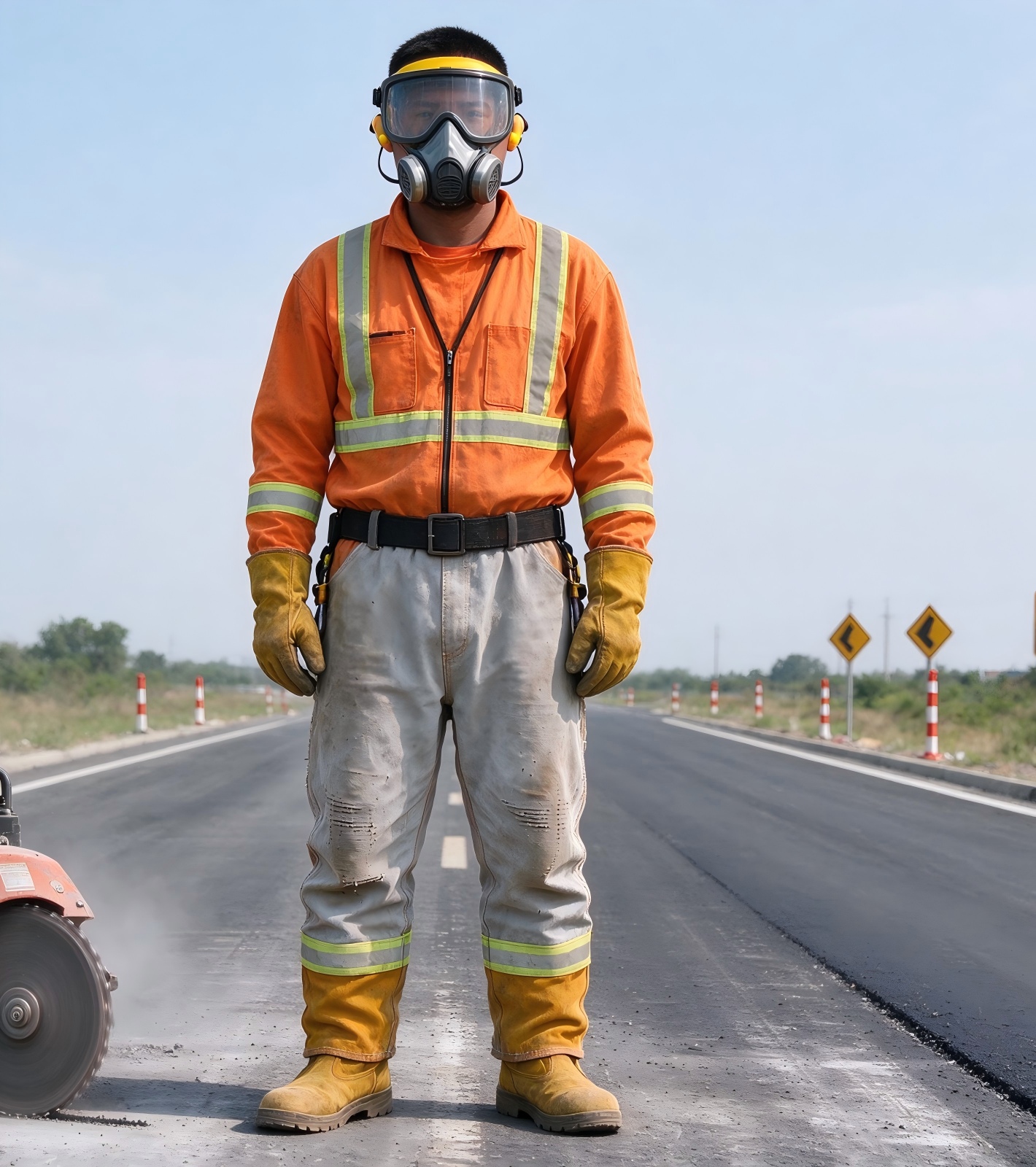
Always remember: never leave the engine running unattended, never transport the machine while it is running; stand only behind the cutter, gripping the handles with both hands throughout the job. This is a baseline, not a suggestion.
Breaking down a proper grooving run gives seven tightly linked steps:
Step | Key Action |
Step 1: Inspect | Complete every item on the pre-operation checklist |
Step 2: Clear | Clear obstacles from the road; confirm a safe cutting path |
Step 3: Start | Start the engine; open the throttle fully |
Step 4: Align | Use the crack-tracking indicator to align with the crack; lower the cutter disc slowly |
Step 5: Set depth | Using the scale, set cutting depth within 0–3 cm as required |
Step 6: Cut | Advance steadily along the crack; stay straight, avoid over-force |
Step 7: Finish | Reduce the throttle slowly, then stop the engine; clear debris; raise the cutter disc |
One point rookies must not overlook is shutdown: snapping the throttle from full straight to stop can cause the engine to "backfire" and damage the unit. The correct way is to ease the throttle down slowly before switching off.
Besides knowing what to do, novices must know what is forbidden. A clear list prevents most accidents:
Forbidden Action | Consequence / Reason |
Standing in front of the machine | Injury from flying gravel |
Standing on machine parts | Loss of balance, falls |
Over-forcing from one side | Off-center groove, loss of control |
Others adjusting controls during work | Mis-operation and danger |
Running the engine unattended | No one to handle sudden faults |
Machines do encounter minor issues in service. The professional approach is logical troubleshooting, not blind disassembly. Novices can self-check these common faults:
Symptom | Check Points |
Lifter not working | Battery voltage at 12V? Switch contacts worn? Relay contact carbonized? |
Engine fails to start | Emergency stop switch open? Battery voltage adequate? Spark plug carbonized? |
Note: if a fault occurs during the warranty period, do not disassemble without the manufacturer's permission — it may void your claim.
After all this talk of procedure and safety, there is a deeper logic: however standardized your operation, it cannot survive an unsafe machine. For a beginner, choosing equipment that is designed to "think ahead for you" is like stopping risk at the door before it arrives. Take one of our road grooving units as an example — here is what it means to be "born for compliance":
· Reliable power: an imported Kohler gasoline engine rated at 25 HP, backed by a three-stage air filtration system (including a pre-cleaner disc) that removes about 98% of airborne contaminants — enough to handle dusty, sand-blown construction sites, maximize engine performance, and extend engine life. Peace of mind begins with a machine that does not die on you;
· Safety braking: press the handle down to brake instantly — no hand changes, no reaching for auxiliary controls. An emergency quick-stop system stops within about 7 seconds, activating to cut electrical power, shut off the engine, and halt blade rotation — the last line of protection in extreme situations when the operator cannot control the machine;
· Precision grooving: an imported six-piece carbide cutter set and small blades, paired with a crack-tracking indicator mounted closest to the cutting head, tracks the crack precisely for a clean, neat groove;
· Easy maintenance: a detachable shaft and an accessible cutter-disc design let you replace cutters in about 20 minutes, with no cutting or welding required — a low skill barrier to servicing;
· Cleaner, low-dust operation: an optional dust collection system with up to 260 m³/hour suction keeps the site cleaner and reduces the impact of dust on people and the environment.
For a novice, the direct payoff of these features is: faster to learn, fewer mistakes, cheaper to maintain, and safer on site.

Getting familiar with a machine starts with reading its specs:
Specification | Reference Value |
Grooving depth | 0–3 cm |
Grooving width | 1–5 cm |
Engine | Imported Kohler gasoline, 25 HP |
Air filtration | Three-stage system |
Fuel tank | 25 L |
Battery | 12V 55AH |
Machine weight | ≈225–245 kg |
Traction | Hand-pushed, single axle, two wheels |
Compliance is not only a matter of what happens during work — it runs through daily upkeep. Check engine oil regularly, clean the air filter, and replace worn cutters in time. Once blades dull, the groove turns ragged and the machine vibrates hard — which in turn damages the engine. Changing cutters may look like extra cost; in reality it is protecting a far more expensive engine. On top of that, clear warranty terms — full machine coverage, lifter coverage, and a well-defined list of wear parts — let a beginner use the equipment without worry.
The grooving machine is the first step in pavement joint sealing, and the step that most tests your sense of "following the rules." For beginners, remember three things: inspect before you start, never skip protection, and follow the procedure step by step. Paired with equipment that is "rule-abiding" in power, safety, precision, and maintenance, you will cut a standard groove — and do the job safely and efficiently, time after time.


