


Views: 0 Author: Site Editor Publish Time: 2026-10-30 Origin: Site


Selecting the right de-icing equipment involves much more than hopper capacity or spread radius. It fundamentally comes down to hard vehicle limitations. Installing a truck mounted salt spreader exceeding your vehicle’s Gross Vehicle Weight Rating (GVWR) compromises handling. It accelerates transmission wear, ruins suspensions, and creates severe legal liabilities in an accident.
Many operators make a critical error during equipment selection. They look at the empty weight of the hopper and assume their truck can handle it. They forget to calculate the massive weight of wet material, the driver, and auxiliary tools. This oversight leads to dangerous driving conditions and catastrophic equipment failure.
This guide breaks down the exact math needed to evaluate capacity. You will learn about material weight variables and equipment categories. We provide the framework necessary to confidently match a spreader to your fleet's true payload limits.
Payload isn't just the spreader: Total payload must account for the empty weight of the spreader, the maximum weight of the de-icing material, the driver, fuel, and any additional tools.
Material density fluctuates: Wet material weighs significantly more than dry rock salt, dramatically shifting your payload utilization mid-storm.
Equipment matching is absolute: 1/2-ton trucks are generally restricted to tailgate spreaders, while 3/4-ton and 1-ton trucks are required for larger truck bed salt spreaders.
Suspension upgrades don't increase payload: Airbags and helper springs improve ride leveling but do not legally or mechanically alter the manufacturer's GVWR.
Ignoring payload limits creates massive risks for your snow removal business. Overloading a vehicle is not just a mechanical issue. It represents a severe compliance failure. Commercial vehicles operate under strict Department of Transportation (DOT) regulations. When you exceed your GVWR, you violate these federal and state standards.
Operating a commercial vehicle over its GVWR voids manufacturer warranties immediately. Dealerships can easily detect stress fractures caused by overloading. Furthermore, insurance companies investigate commercial accidents thoroughly. If an adjuster discovers your overloaded vehicle caused a crash, they can deny your commercial insurance claim. This leaves your business entirely responsible for damages, medical bills, and legal fees.
Consistent overloading destroys your truck from the inside out. It leads to premature rear axle failure. The transmission works harder to move the excessive weight, causing the fluid to overheat and degrade. Braking distances increase dramatically. Your brake pads and rotors will burn out faster. You lose steering responsiveness because the heavy rear load lifts the front tires off the pavement.
Some operators try to save money upfront. They force a high-capacity hopper onto a lighter truck. These savings disappear quickly. Emergency maintenance costs during peak winter events will erase your profit margins. When a truck breaks down mid-storm, you cannot service your clients. You lose revenue, and you damage your professional reputation.
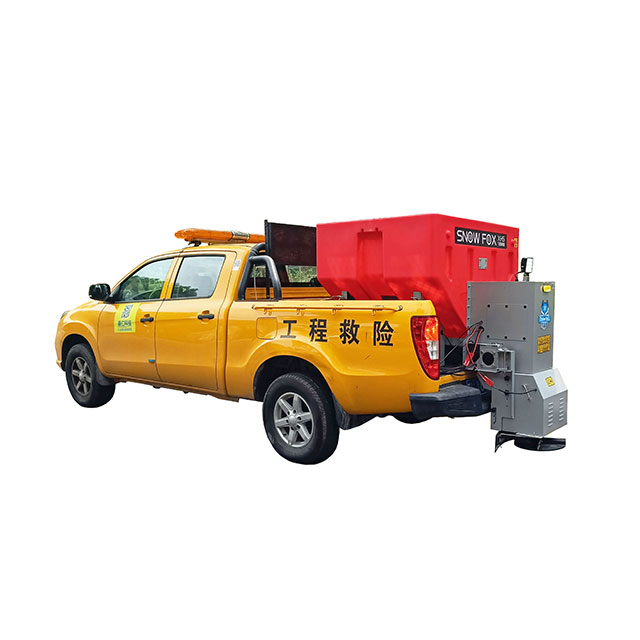
Guessing your payload capacity is a dangerous game. You must use precise mathematics to ensure safety and compliance. The process requires finding your baseline numbers and subtracting every single item you put into the truck.
Follow these exact steps to determine your true available payload:
Establish the baseline GVWR: Locate the vehicle’s GVWR on the driver’s side door jamb. Do not use internet search results for this number. Factory options change the rating. For this example, assume a GVWR of 10,000 lbs.
Determine exact curb weight: Weigh the empty truck on a certified scale. Fill the gas tank completely before weighing. Factory curb weight estimates rarely include heavy aftermarket bumpers or upgraded tires. Assume our scale reads 6,500 lbs.
Factor in human and auxiliary weight: Subtract the weight of the driver and any passengers. Subtract the snow plow if you have one attached. Subtract cab tools, emergency kits, and chains. Let us estimate this at 800 lbs.
Calculate maximum spreader allowance: Subtract the curb weight and auxiliary weight from the GVWR. The remaining number is your absolute maximum allowance. This must cover both the empty spreader and the loaded salt.
Payload Calculation Example
| Weight Category | Pounds (lbs) | Calculation Step |
|---|---|---|
| Gross Vehicle Weight Rating (GVWR) | 10,000 | Starting Baseline |
| Actual Curb Weight (Full Tank) | - 6,500 | Subtract from GVWR |
| Driver, Plow, and Tools | - 800 | Subtract from Remaining |
| Maximum Spreader + Material Allowance | 2,700 | Final Available Payload |
In this scenario, you have 2,700 lbs available. If you buy a hopper weighing 700 lbs empty, you can only safely carry 2,000 lbs of de-icing material. Always keep this formula in mind before making an equipment purchase.
Choosing between equipment styles depends entirely on your truck's classification. You cannot put a massive V-box in a light-duty pickup. Understanding the limitations of each category ensures you buy the right tool for the job.
Tailgate models attach directly to the rear hitch receiver. They are compact and highly maneuverable.
Typical empty weight: 100 to 250 lbs.
Use case: Best suited for 1/2-ton pickups, SUVs, or UTVs. They work perfectly for residential driveways and small commercial lots.
Limitations: Lower material capacity limits your route length. You will need to return to the salt pile frequently. However, this design protects light-duty rear suspensions from bottoming out.
V-box models slide directly into the cargo area. They carry massive amounts of material for long commercial routes.
Typical empty weight: 400 to 800+ lbs. This varies heavily between poly and stainless steel construction.
Use case: You absolutely need a 3/4-ton or 1-ton truck to run a pickup truck salt spreader of this size. Light-duty trucks will buckle under the loaded weight.
Evaluation dimension: Consider poly hoppers over steel if you have tight payload margins. Polyurethane sheds significant empty weight. You do not sacrifice internal volume. This allows you to carry more actual salt.
Spreader Type Capacity Comparison
| Spreader Type | Ideal Vehicle Class | Average Empty Weight | Best Application |
|---|---|---|---|
| Tailgate Spreader | 1/2-Ton, SUV, UTV | 100 - 250 lbs | Driveways, Small Lots, Tight Spaces |
| Poly V-Box | 3/4-Ton, 1-Ton | 400 - 600 lbs | Commercial Routes, Weight-Conscious Fleets |
| Stainless Steel V-Box | 1-Ton, F-450/550+ | 600 - 900+ lbs | Heavy Commercial, Extreme Durability Needs |
If you manage large properties, a truck bed salt spreader is mandatory for efficiency. Just ensure your vehicle chassis matches the heavy-duty requirement.
Many contractors miscalculate their payload because they misunderstand material density. Volume does not equal weight. A cubic yard of dry rock salt weighs much less than a cubic yard of wet sand. Failing to account for this fluctuation will overload your truck instantly.
Standard dry rock salt averages roughly 80 lbs per cubic foot. If you own a 1.5 cubic yard hopper, it holds about 40 cubic feet of material. Filling this hopper with dry salt adds roughly 3,200 lbs to your truck bed. For a 1-ton truck, this usually falls within a safe operating range.
Weather conditions change rapidly. Snow mixes with rain. Salt piles sit uncovered and absorb moisture. Treated salt mixtures and wet sand easily weigh up to 120 lbs per cubic foot.
Take that same 1.5 cubic yard hopper. Fill it with wet sand. It now holds 4,800 lbs of material. You just added 1,600 extra pounds to your rear axle without changing the volume. This massive swing catches inexperienced operators off guard.
You must adopt a worst-case scenario mindset. Never calculate your payload based on dry salt alone. Follow these best practices:
Assume the heaviest possible material will enter your hopper at some point.
Calculate your maximum payload using 120 lbs per cubic foot as a baseline.
Create a safe buffer margin. Leave at least 10% of your GVWR unused to account for ice buildup on the truck frame.
Train your loader operators. Teach them not to overfill hoppers when handling wet sand.
Weight is the primary concern, but it is not the only implementation reality. A heavy-duty salt spreader strains other vehicle systems. You must prepare your truck's electrical and suspension components for the grueling winter season.
A large electric motor requires substantial amperage. When you activate the auger and the spinner simultaneously, the power draw spikes. Now add your plow hydraulics. Add your strobe lights, heater, and headlights.
Standard factory alternators struggle to handle this combined load. The voltage drops. This burns out electric spreader motors prematurely. Ensure your truck has a high-output alternator. Install dual batteries if possible. Upgrading your electrical charging system prevents mid-storm equipment failure.
Even if your calculated load sits safely within the GVWR, the truck might sag in the rear. A sagging rear end creates dangerous driving dynamics. It aims your headlights into the sky, blinding oncoming traffic. It reduces weight on the front tires, destroying your steering control.
Many operators install Timbrens, helper springs, or air suspension kits. These products level the ride. They keep the truck horizontal under heavy loads.
Cautionary note: Suspension upgrades do not increase your legal payload limit. They only stabilize the permitted weight. A sticker on your door determines your legal limit. Adding airbags does not change that federal sticker.
Sometimes the math simply does not work out. Your current fleet might lack the payload capacity for a bed-mounted V-box. Do not force an unsafe setup.
Instead, evaluate tow-behind options. Pulling a trailer shifts the heavy load distribution off the truck's rear axle. A 1/2-ton truck can safely tow much more weight than it can carry in the bed. This alternative keeps your business compliant while allowing you to spread high volumes of material.
Purchasing de-icing equipment requires working backward from your vehicle's door placard. You cannot guess your way to a safe fleet. Start by establishing hard numbers.
First, verify the available payload. Account for the actual curb weight, snow plows, and passengers. Second, calculate the maximum weight of the heaviest material you will ever spread. Always assume you will encounter wet sand. Third, evaluate your electrical and suspension readiness.
Only after completing these steps should you select a tailgate or V-box model. Make sure it fits comfortably within your remaining weight margin. Ignoring this mathematical framework guarantees equipment failure. It destroys your trucks, risks driver safety, and exposes your business to unacceptable liability risks.
A: Generally, no. Even a small 1-yard V-box loaded with wet salt quickly exceeds the rear axle weight rating (GAWR). It surpasses the overall payload of a standard 1/2-ton truck, leading to severe handling issues and mechanical damage.
A: Yes. A poly hopper can weigh 150-200 lbs less than its stainless steel counterpart. While this won't upgrade a truck to a new class, it provides a critical buffer for extra material weight.
A: The weight of the plow (often 400-800 lbs) must be subtracted from your total truck payload. You must do this before calculating the remaining capacity you have left for your pickup truck salt spreader.


