


Views: 0 Author: Site Editor Publish Time: 2026-11-11 Origin: Site


A small patch can receive the wrong amount of tack even when the crew measures the liquid accurately. The mistake often begins on the work sheet. A specification gives the asphalt binder that should remain after the water leaves, while the crew measures the emulsion passing through the tack coat sprayer. Those quantities have different meanings. A usable field calculation starts with the specified residual rate and the binder content of the material as delivered. It then accounts for any permitted dilution and turns the result into a liquid quantity for the actual repair area.
The residual asphalt rate describes how much asphalt binder should be left on the treated surface. An asphalt emulsion contains binder dispersed in water, so the amount of liquid sprayed is generally greater than the amount of binder that remains. The emulsion spray rate describes the volume of liquid applied per unit of area before the water leaves.
The distinction matters whenever a document says “application rate” without naming the material basis. A specification may give a residual rate, a rate for the product as supplied, or a rate for an identified diluted mixture. Before using a number, write down which basis it represents. A crew that treats a residual rate as a sprayer output target will apply too little binder when the liquid contains water.
A second distinction is the point at which a supplier describes the material. As delivered means the product in the container or tank that arrived at the site. That product may already have been diluted or supplied at a specified concentration. As sprayed means the actual liquid leaving the nozzle. Those are the same only when the crew makes no further approved change. Work from the confirmed binder content of the material in use, and ask the supplier or project inspector to resolve an unclear label.
| Quantity on the work sheet | What the number describes |
|---|---|
| Residual asphalt rate | Binder intended to remain per unit of treated area |
| As-delivered emulsion rate | Amount of the delivered product required per unit area |
| As-sprayed liquid rate | Amount of the final mixture leaving the sprayer per unit area |
| Total spray volume | As-sprayed liquid rate multiplied by the measured treated area |
Coverage is a separate matter. Two patches can receive the same total volume and have different results if one gets a uniform film and the other has dry spots and puddles. Confirm the quantity and look at how it was distributed. A measured volume is valuable because it gives the crew a check that is independent of appearance.
Get the target residual rate and allowable material from the job documents. Surface condition helps explain why one approved rate may differ from another. A milled or open-textured surface can require a different residual target from a dense, smooth surface. Use the specified target for the work area so a general example does not become an unintended change to the job requirements.
Next, confirm the binder fraction and its units. A data sheet may report residue as a percentage by mass, while the spray target is in liters per square meter. A mass percentage cannot be used directly as a volume fraction. Ask for the equivalent volume information or the densities and conversion procedure required by the project. For a mass-based calculation, keep the binder target and final material quantity in compatible mass units, then convert to the required metering unit using the appropriate data.
Check whether the project permits dilution and who controls it. If a supplier delivers a pre-diluted product, use that product's confirmed binder fraction. If further dilution is authorized, record the basis of the ratio and the measured volumes or weights. A note such as “one to one” is insufficient unless it identifies both components and the measurement basis.
Finally, measure the actual area that will be sprayed. A patch can have an irregular bottom and sidewalls. Follow the project instructions for which surfaces require tack, and include those surfaces in the estimate where applicable. If two patches have different surface conditions or specified rates, calculate their volumes separately. Combining them too early can hide the reason the crew needs two targets.
When comparing asphalt emulsion sprayers, check whether the equipment lets the operator verify liquid consumption for the size of the work. A large gauge increment may work well for longer runs and be hard to read for one small patch. The useful question is whether the planned field check can distinguish the target dose from normal measurement variation.
Use the same area units throughout. In this illustrative example, the specified residual target is 0.20 liters of binder per square meter, the as-delivered emulsion contains 60% binder by volume, and the measured area is 12 square meters. These values demonstrate the calculation.
For the product as delivered, divide 0.20 by 0.60. The result is about 0.333 liters of emulsion per square meter. Multiply by 12 square meters and the target volume is 4.0 liters. You can check it in reverse. Four liters of liquid at a 60% binder fraction contains 2.4 liters of binder, which provides the original 0.20-liter target across 12 square meters.
Now assume the project explicitly permits adding one measured volume of water to one measured volume of that emulsion. In the simplified volume calculation, the liquid volume doubles while the binder quantity remains the same. The final binder fraction is approximately 30%. Divide 0.20 by 0.30 to get about 0.667 liters of diluted liquid per square meter, or 8.0 liters for the same patch area. The amount of binder is still 2.4 liters. Use the applicable project calculation or supplier-provided conversion if the specified method differs.
| Example for the same 12 m² area | As delivered | After authorized 1:1 volume dilution |
|---|---|---|
| Binder fraction used in the example | 0.60 | 0.30 |
| Target residual binder rate | 0.20 L/m² | 0.20 L/m² |
| Calculated liquid spray rate | 0.333 L/m² | 0.667 L/m² |
| Target liquid applied | 4.0 L | 8.0 L |
Keep sufficient precision in the intermediate calculation and round only to a usable field value at the end. A small rounding difference in the rate may become significant over many patches. On the worksheet, keep the project target, the material basis, and the final liquid target in separate cells or columns. A supervisor should be able to trace the final number without guessing which dilution was used.
Choose a test area that is representative of the work and large enough for the measurement method. Determine the liquid consumed using the approved method, then divide by the actual treated area. Compare that measured liquid rate with the calculated liquid target on the same basis. If the test starts with an empty hose or includes material returned to the source, account for that difference under the equipment procedure before treating the reading as sprayed volume.
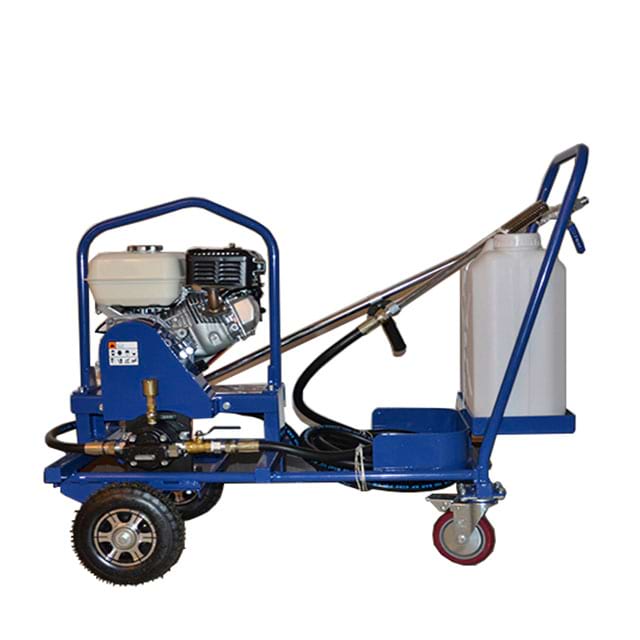
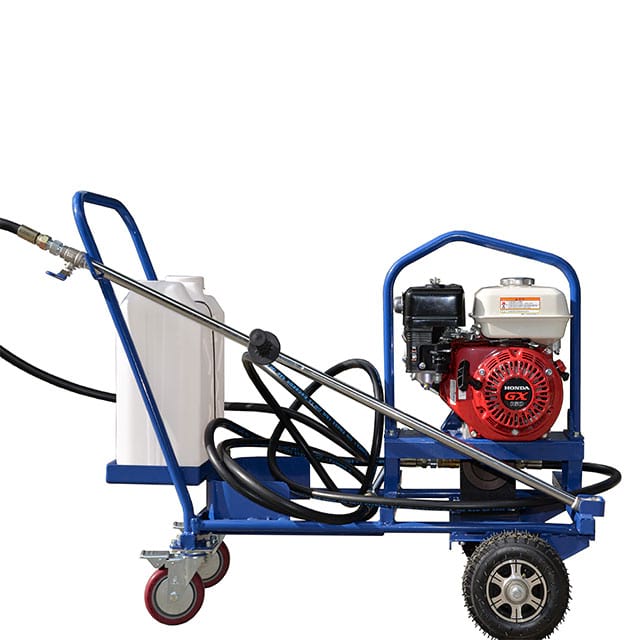
A hand-push bitumen emulsion sprayer suits small repair areas where the operator needs to move between individual patches. For this kind of work, travel pace, effective spray width, and the amount of overlap all influence coverage. A change in how the operator handles the wand can change the amount deposited per area even if the pump setting is unchanged. Verify the working setup as a whole.
If a test is off target, inspect the two parts of the result. A uniform pattern with too much or too little liquid points toward the application setting, pace, or calculation basis. An uneven pattern points toward the nozzle, coverage width, overlap, or another distribution issue. Resolve any equipment problem through the applicable service or operating procedure before conducting another test. Record the change and repeat the measurement so the crew knows which setting produced the final result.
Watch the scale of the correction. If the measured test volume misses the target by roughly the same amount as the uncertainty of the measuring device, repeat the test with a better measurement basis before changing the sprayer setting. For example, a longer representative pass may give a clearer reading than several tiny areas measured with a coarse gauge. Once the field result is repeatable, check that the same pace and effective width can be maintained at actual repair stops, especially around edges and other places where the operator changes direction.
Leave the crew a simple job record. Identify the material, residual target, confirmed concentration, whether dilution was authorized and used, test area, consumed volume, measured liquid rate, and coverage observation. Where a job spans several shifts, that record helps the next operator reproduce the setup and see when a change of product or surface calls for a fresh calculation.
Set a tack coat sprayer from the residual binder target by first identifying the concentration of the liquid that will actually be sprayed. Convert on a consistent mass or volume basis, then verify the result on an area the crew can measure reliably. For small repairs, the field record should preserve the calculation and the coverage check together. Fanuode is a road maintenance equipment company with a hand-push emulsion sprayer for localized work. When reviewing such a machine, consider how accurately the crew can measure consumption and repeat the selected application setup.
A flow rating is a volume per unit time. Application rate is a volume per unit area. To relate the two, you also need the area covered in that time, including the effective width and the actual operating pace. A measured field trial captures those variables directly.
Use the approved measurement approach or a representative test area large enough for a meaningful reading. The change in measured volume should be clearly larger than the instrument's normal reading uncertainty. Check that the larger area still represents the material, coverage, and operating setup planned for the patches.
Yes, when the areas share the same target rate, material basis, and concentration. Calculate separately where those inputs differ, then add the required volumes for planning. Keep the individual values so the crew can apply the correct amount to each group of patches.
Appearance can help identify dry areas, streaks, and heavy spots. Quantifying residual binder requires a measurement of the liquid applied and a reliable binder fraction on the correct basis, or the measurement method required by the project.
Check the new delivery's binder content and delivery condition first. If the binder fraction or dilution status changes, recalculate the liquid target and verify the application again. Keep the two delivery records separate so each crew knows which calculation applies.


